

We have a passion for unconventional solutions that bring your vision to life.
The international standard ISO 14644-1:2015 (Cleanrooms and associated controlled environments — Part 1: Classification of air cleanliness by particle concentration) classifies cleanrooms into nine classes (ISO 1 through ISO 9) based on the maximum allowable concentration of airborne particles per cubic meter at defined particle sizes.
Classifications are determined at rest and/or in operation using standardized particle-counting methods defined in ISO 14644-2, and must be periodically requalified. The lower the class number, the cleaner the environment:
ISO Class | Particles/m³ ≥ 0.5 µm (approx.) | Typical Role |
ISO 1–3 | < 10 | Ultra-high-purity semiconductor research |
ISO 4 | 352 | Specialized nanotechnology |
ISO 5 | 3,520 | Aseptic processing, product exposure |
ISO 6 | 35,200 | Support for ISO 5, some sterile compounding |
ISO 7 | 352,000 | Background zones, buffer rooms, gowning |
ISO 8 | 3,520,000 | General GMP production, outer gowning |
ISO 9 | 35,200,000 | Controlled non-clean ambient space |
Classification alone does not guarantee sterility. Particle counts measure inert contamination control; microbiological control requires additional measures — gowning, disinfection, aseptic technique, and viable monitoring — governed by GMP regulations such as EU GMP Annex 1 and FDA aseptic processing guidance.
Definition and Limits
An ISO 5 cleanroom permits no more than 3,520 particles per cubic meter of air at ≥0.5 µm. Under EU GMP Annex 1, the equivalent "Grade A" environment applies to the critical zone where sterilized product, components, or product-contact surfaces are exposed.
Engineering Characteristics
Air changes per hour (ACH): typically 240–600 ACH; EU GMP Annex 1 requires a unidirectional air speed of 0.36–0.54 m/s at the critical zone in Grade A.
Airflow type: unidirectional (laminar) flow — vertical or horizontal — that continuously sweeps particles away from the exposed product.
Filtration: terminal HEPA (H14) or ULPA filters, usually installed as a full filter ceiling directly above the critical operation.
Monitoring: continuous non-viable particle monitoring at the point of fill, plus frequent viable air and surface sampling during operations.
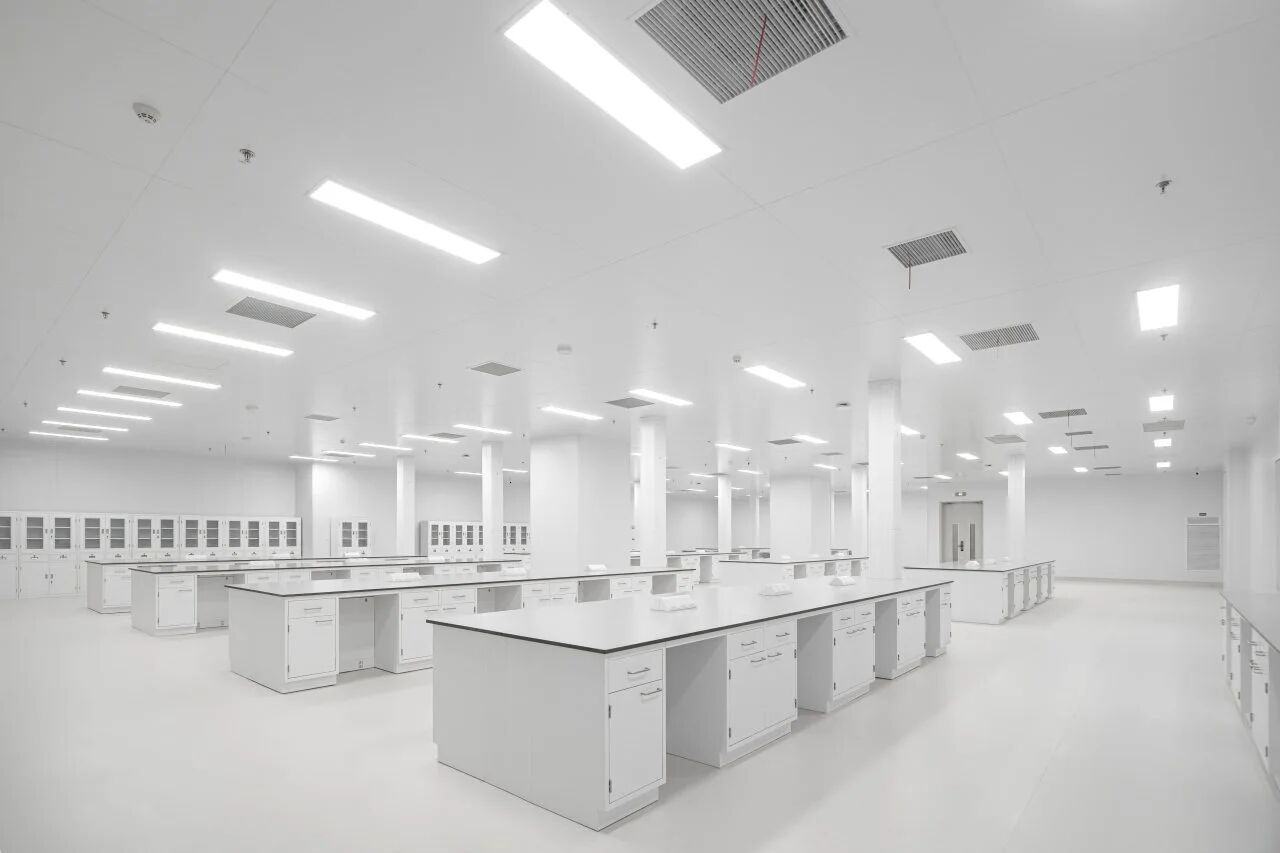
Aseptic filling and stoppering of sterile products
Sterile filtration connections and open manipulations of sterile fluids
Assembly of sterile product-contact components
Cell therapy formulation and final product transfer in sterile packaging
Operations inside RABS (Restricted Access Barrier Systems) or isolators
ISO 5 is rarely a whole room. In modern facilities it is typically a first-air zone inside an isolator or RABS, or a laminar airflow (LAF) hood, nested within an ISO 7 background.
Continuous monitoring systems (with alarm thresholds well below the classification limit) are expected by regulators — Annex 1 explicitly discourages relying solely on post-batch review of particle data.
Personnel intervention into the ISO 5 zone is the single greatest contamination risk; facility design should aim for low-intervention operations rather than procedural control alone.
Definition and Limits
An ISO 7 cleanroom permits up to 352,000 particles per cubic meter at ≥0.5 µm. In EU GMP terms it corresponds broadly to Grade B — the background environment for Grade A aseptic operations — though exact equivalence depends on the operational state (at rest vs in operation) and on microbial limits, which are defined separately in Annex 1.
Engineering Characteristics
Air changes per hour: typically ≥30 ACH for operational classification, with higher rates common in high-activity rooms.
Airflow type: non-unidirectional (turbulent dilution) airflow; ceiling-supply HEPA filtration with low-level wall or floor returns.
Pressure cascade: positive pressure of 10–15 Pa relative to the adjacent lower-class room, ensuring air flows from clean to less clean.
Monitoring: differential pressure, temperature, humidity, total particle counts at defined intervals, and routine viable monitoring.
Where ISO 7 Is Used
Background environment surrounding ISO 5 aseptic zones (the dominant use case)
Buffer rooms and staging areas for sterile compounding
Inner gowning rooms on the path to aseptic areas
Downstream purification, media preparation, and equipment staging
Cell culture expansion and many closed-process biotech steps
Many medical device assembly and packaging operations
Practical Implementation Notes
The ISO 7 room does not "protect" the ISO 5 zone by particle count alone — it protects it through dilution, pressure cascade, and disciplined personnel/material flow. All three must be validated together.
Turbulent airflow means contamination control depends heavily on protocol: gowning discipline, cleaning frequency, and limiting room occupancy to qualified personnel.
Attribute | ISO 5 | ISO 7 |
Particle limit (≥0.5 µm) | 3,520 particles/m³ | 352,000 particles/m³ |
Relative cleanliness | 100× cleaner | Baseline background |
Air changes per hour | 240–600 ACH (unidirectional) | ≥30 ACH (turbulent) |
Airflow design | Unidirectional (laminar) | Non-unidirectional (turbulent) |
Filtration | Terminal HEPA/ULPA, full coverage | HEPA ceiling supply |
EU GMP equivalent | Grade A | Grade B |
Typical energy demand | Very high | Moderate |
Construction complexity | High (integration with RABS/isolator) | Moderate |
Primary applications | Aseptic fill-finish, sterile filtration, open sterile manipulations | Buffer rooms, background zones, inner gowning, downstream processing |
Monitoring intensity | Continuous particle + viable sampling | Periodic particle, pressure, environmental monitoring |
The Cost Dimension
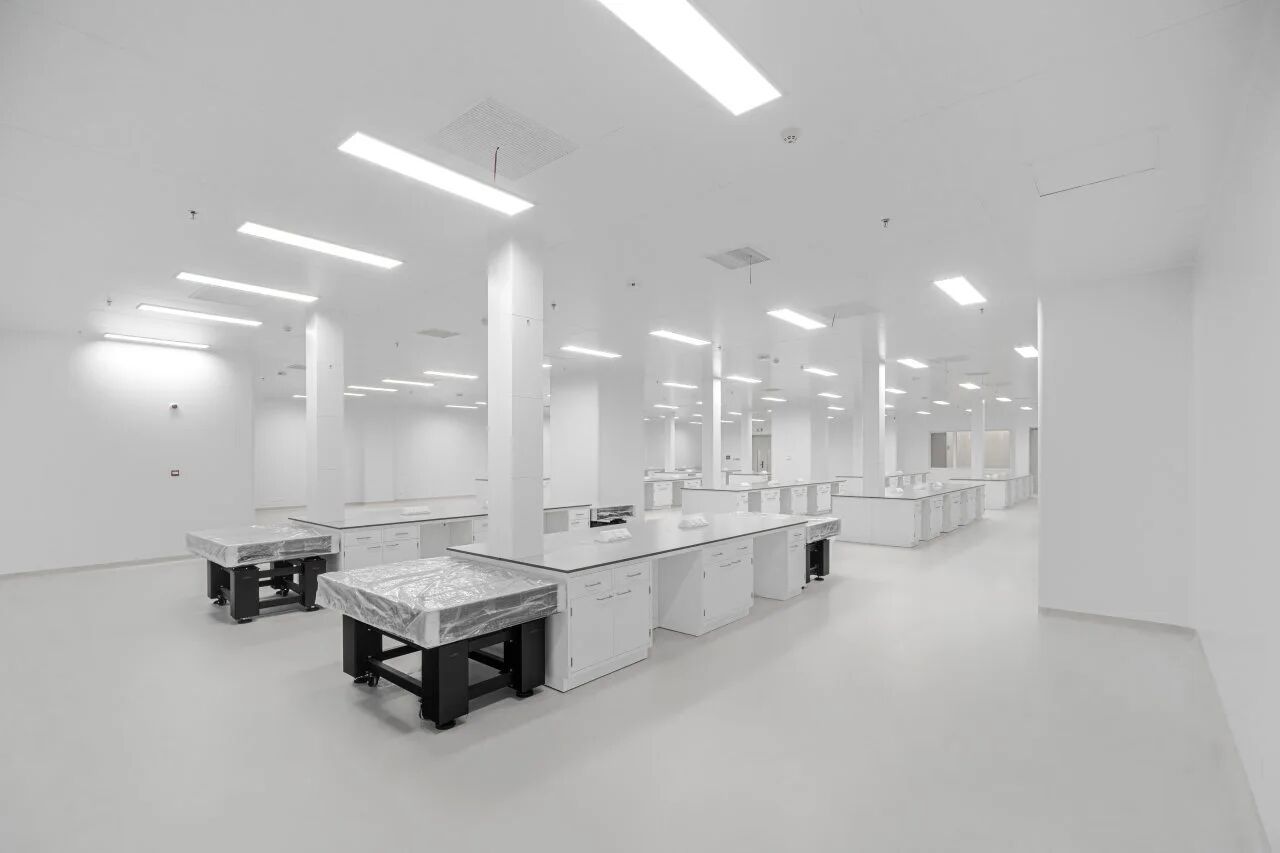
Because ISO 5 environments move 8–20 times more air than ISO 7 rooms, their HVAC energy consumption, filter replacement cost, and verification burden are dramatically higher. This is precisely why modern facility design minimizes the ISO 5 footprint to only the critical zone — a full-room ISO 5 design is rarely economically justifiable when an isolator or RABS can deliver the same protection within an ISO 7 background.
GMP facilities layer cleanliness in a cascade, moving from lower to higher cleanliness as personnel and materials approach critical operations:
1. ISO 8 — ante-room, outer gowning, material airlock entry
2. ISO 7 — inner gowning, buffer room, background for aseptic operations
3. ISO 5 — the critical aseptic processing zone (often within RABS/isolator)
Personnel Flow
Operators gown in stages: street clothes to scrubs in ISO 8, sterile gowning in ISO 7, and final sterile gloves and sanitization before entering or reaching into the ISO 5 zone. Interlocked doors and airlocks between zones prevent pressure disruptions and particle migration.
Material Flow
Components enter through dedicated material airlocks or pass-through chambers with HEPA-filtered air showers, are surface-disinfected (sporicidal where required by Annex 1), and are staged in ISO 7 before transfer into the ISO 5 critical zone.
Why the Cascade Matters
Each zone enforces a positive pressure differential relative to the dirtier adjacent space. Air always moves from clean to less clean, so contamination is progressively diluted as it would travel toward the product. A defect anywhere in the cascade — a broken pressure differential, an unsealed pass-through, an ungowned operator — compromises every zone downstream of it. Regulators treat the zoning strategy as a whole: layout, HVAC interlocks, SOPs, and monitoring data must tell one consistent story.
EU GMP Annex 1 (2022 revision, "Manufacture of Sterile Medicinal Products") is the most influential sterile-manufacturing standard worldwide. It maps Grade A to ISO 5 at rest for particles, adds its own microbial limits, mandates a Contamination Control Strategy (CCS), and expects continuous particle monitoring of Grade A during operations. It also formalizes the requirement that Grade A zones be surrounded by Grade B background — i.e., ISO 5 nested in ISO 7.
FDA Aseptic Processing Guidance (2004) similarly requires ISO 5 (Class 100/M 3.5) conditions wherever sterile product or components are exposed, with ISO 7 (Class 10,000) surrounding support areas.
ISO 14644-2 defines requalification intervals and routine monitoring plans; classification alone without a monitoring program will not satisfy inspectors.
Other regional GMPs (WHO, PIC/S, China GMP) are harmonized to the same principles, meaning an Annex 1-aligned zoning design travels well across markets.
Facilities that can demonstrate their zoning strategy through physical layout, validated pressure cascades, air-change-rate studies, and continuous environmental monitoring data are far better positioned for inspection success — and for faster product release.
Ask these questions in order for each process step:
1. Is the sterile product or a product-contact surface exposed to room air?
Yes → ISO 5 (ideally within an isolator or RABS with an ISO 7 background)
No (closed process, validated closed transfer) → continue
2. Is the operation a direct support step for the aseptic zone (gowning, staging, buffer prep)?
Yes → ISO 7
No → continue
3. Is it general controlled manufacturing or logistics with no sterility claim?
Yes → ISO 8 is usually sufficient
Two additional rules of thumb:
Classify for the operation, not the ambition. Over-classifying spaces wastes energy and validation effort; under-classifying risks batch losses and regulatory action. The right level is the lowest cleanliness that demonstrably protects the product.
Minimize the ISO 5 footprint. Every square meter of ISO 5 costs far more to build, run, and monitor than ISO 7. Barrier technology (isolators, RABS) lets you shrink the critical zone dramatically.
Both ISO 5 and ISO 7 environments must pass a formal qualification lifecycle before use:
l Installation Qualification (IQ): verify the as-built facility matches design specifications — filter integrity, ductwork, controls, room finishes.
Operational Qualification (OQ): demonstrate airflow velocity and uniformity, recovery (cleanup) tests, filter leak (scan) tests, pressure cascade, temperature, and humidity.
Performance Qualification (PQ): classify the rooms per ISO 14644-1 in the defined occupancy state, and demonstrate microbial environmental monitoring performance over an extended run.
Ongoing requalification: per ISO 14644-2 and internal policy — typically annually for particle classification, plus continuous or routine monitoring with trend review, alert and action limits, and investigation of excursions.
Traditional stick-built cleanrooms tie classification decisions to permanent construction. For organizations scaling toward clinical or commercial manufacturing — or operating multi-product facilities — modular cleanroom platforms offer a materially different risk profile:
Pre-engineered, pre-tested units (such as G-CON PODs) arrive with integrated HVAC, unidirectional airflow, and built-in environmental monitoring, shrinking qualification timelines.
Independent POD-level control allows each ISO class to be isolated, monitored, and reconfigured without disrupting neighboring validated areas.
Faster deployment answers the core problem in modern biotech: capacity is needed in months, not years, and process changes must not trigger facility-wide revalidation.
Zoning made physical: an ISO 7 POD serving as a dedicated buffer room can feed a neighboring ISO 5 POD used for aseptic filling, with pressure-controlled interconnections — the cascade strategy implemented in hardware.
Treating classification as a checkbox. A room classified ISO 5 at rest can fail badly in operation if personnel interventions and gowning discipline are poor. Annex 1's holistic Contamination Control Strategy exists for a reason.
Underestimating the background. A perfect isolator inside a neglected ISO 7 room will show rising viable counts and pressure excursions. The background zone is part of the sterile barrier.
Over-building ISO 5. Whole-room ISO 5 designs inflate energy cost and monitoring burden while adding no protection over a properly designed barrier system in ISO 7.
Weak monitoring data review. Collecting continuous data but reviewing it only after batch completion is an explicit Annex 1 concern; build alarm logic and routine trending into the monitoring plan.
Ignoring recovery (cleanup) performance. How fast a room returns to baseline after a disturbance matters as much as its steady-state classification.
Strategic Takeaways
Use ISO 5 only where product or product-contact surfaces are exposed — aseptic filling, sterile filtration, open sterile manipulations — and prefer isolators or RABS to minimize the ISO 5 footprint.
Use ISO 7 as the protective background supporting ISO 5, plus buffer rooms, inner gowning, and downstream processing.
Maintain the cascade: pressure differentials, air change rates, and airflow direction are the machinery of contamination control; validate them as a system.
Design for unidirectional personnel and material flow with staged gowning and disinfected material transfers.
Qualify and monitor rigorously: IQ/OQ/PQ, ISO 14644-2 requalification, continuous particle monitoring, and viable trending.
Consider modular cleanrooms to deploy, scale, and reconfigure ISO 5/ISO 7 capacity without construction delays or revalidation disruption.
ISO 5 permits 3,520 particles/m³ at ≥0.5 µm versus 352,000 for ISO 7 — a 100-fold difference in allowable airborne particulates.
For aseptic operations, yes. ISO 5 is required wherever sterile product is exposed, and regulators (EU GMP Annex 1, FDA) expect an ISO 7 / Grade B background around it.
They are closely related but not identical. ISO 7 is a particle classification under ISO 14644-1; Grade B is a GMP grade that adds microbial limits and is defined in specific occupancy states. A Grade B room must meet ISO 7 particle limits at rest, but the reverse is not automatic.
ISO 5 unidirectional zones typically run 240–600 air changes per hour (or 0.36–0.54 m/s air speed per Annex 1); ISO 7 rooms typically run at least 30 ACH. Actual values depend on room geometry, occupancy, and heat load, and are fixed during qualification.
Yes. Modular units can be engineered and validated to ISO 14644-1 and cGMP requirements, with independent HVAC, monitoring, and certification per unit.
Through IQ/OQ/PQ qualification, ISO 14644-1 classification in defined occupancy states, and ongoing monitoring of particle counts, viable contamination, differential pressure, air changes, temperature, and humidity with alert/action limits.
ISO 14644-1:2015 — Classification of air cleanliness by particle concentration
ISO 14644-2 — Monitoring to provide evidence of cleanroom performance related to air cleanliness by particle concentration
EU GMP Annex 1 (2022) — Manufacture of Sterile Medicinal Products
FDA Guidance for Industry: Sterile Drug Products Produced by Aseptic Processing (2004)
Executive Summary
In regulated manufacturing, cleanroom classification is not a technical detail — it is a foundational design decision that determines product sterility, regulatory compliance, capital cost, and operational flexibility for the entire life of a facility. Two classifications dominate sterile pharmaceutical and biotech operations: ISO 5 and ISO 7.
The relationship between them is best understood as a partnership rather than a competition. ISO 5 provides the ultra-clean environment required wherever sterile product is directly exposed to air; ISO 7 provides the protective background environment that makes sustained ISO 5 conditions possible. A facility that gets this layering wrong will fail environmental monitoring, struggle through inspections, and put patients at risk. A facility that gets it right achieves compliance, efficiency, and scalability at the same time.
This guide explains the technical definitions of ISO 5 and ISO 7, compares them side by side, shows how they work together in a GMP zoning cascade, and provides a practical decision framework for choosing the right classification for every stage of your process.

Wiskind Cleanroom specializes in cleanroom enclosure system , ceiling system, cleanroom doors and windows and related product development, manufacturing, sales, consulting and services.

 Chinese
 English
 Russian
 French
 Spanish
 Portuguese
 Arabic
 Korean
 German
 Japanese
 Thai
Thai Hindi
Hindi